
The Missing Discipline Between a Difficult Question and a Defensible Answer
A strong evidence base matters. So does the process through which people decide what it means.
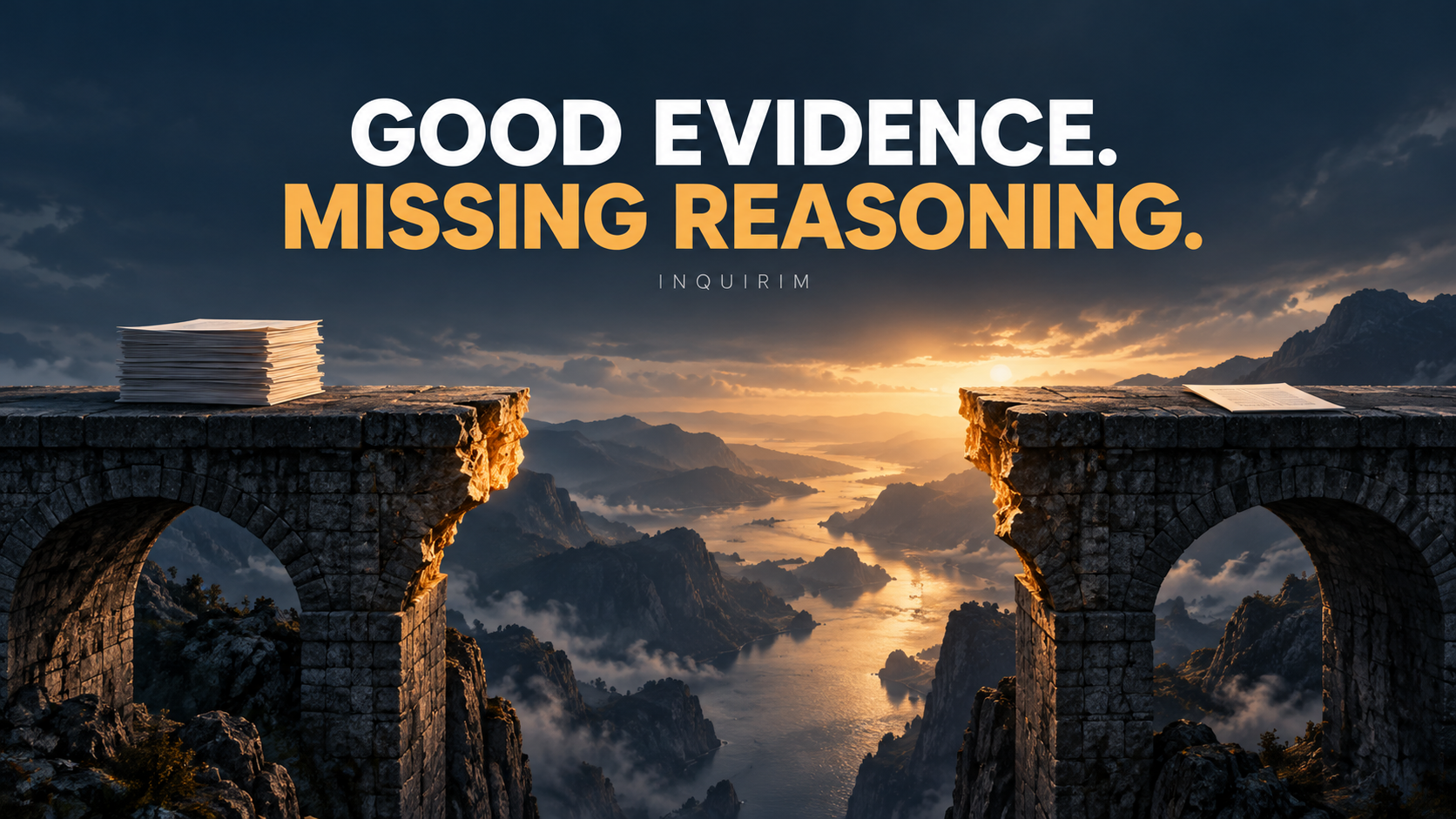
A strong evidence base matters. So does the process through which people decide what it means.
An organisation can explain who approved a decision, how much it will cost and how its delivery will be monitored. It may find it harder to explain how the question was examined before the recommendation emerged.
Who decided what needed answering? Which interpretations received serious attention? What happened to the concern that did not fit the emerging view? Which assumptions became so familiar that nobody thought to record them?
These questions concern the work that turns an uncertain situation into an answer people are prepared to act upon.
I have been developing INQUIRIM around the possibility that this work deserves more explicit treatment as a discipline.
A familiar organisational problem
Consider a hypothetical organisation deciding whether to replace several local services with one central digital service.
It commissions research, consults users, models costs and gathers specialists. The finance team examines affordability. Operational colleagues consider delivery. Legal advisers identify obligations. A project team prepares the business case.
Each contribution may be competent and useful.
But someone still has to examine how they fit together.
Does evidence of lower transaction costs establish that the service will work better overall? Does positive feedback from current digital users tell us enough about people who cannot use the proposed service? Is the recommendation dependent on an assumption about demand that nobody has tested?
A summary can accurately describe each team's findings while leaving those relationships unresolved.
The difficult work lies in judging what the contributions collectively support, where they conflict and what remains unknown. That work needs a method too.
There is already a great deal to build upon
Calling this a missing discipline invites an obvious objection: inquiry already has disciplines.
That objection is justified.
Research methodology, operational research, intelligence analysis and other established fields offer substantial approaches to framing problems, assessing evidence and reaching judgements.
The UK Government's AQuA Book, for example, addresses the production of robust analysis, including engagement, scoping, assumptions and uncertainty. The UK intelligence assessment community's Common Analytical Standards address coherent reasoning, alternative hypotheses, contradictory information and an auditable evidence base.
It would be wrong to suggest that these principles begin with INQUIRIM.
The question I am exploring is narrower: when people from different professions assemble around a difficult shared question, do they have a consistent way to conduct the inquiry together?
They may bring excellent individual disciplines without sharing a method for connecting them. A meeting agenda can organise their time. A consultation can collect their views. Neither necessarily establishes how claims will be examined, disagreements retained or conclusions constructed.
The potential gap is between those contributions.
What would make inquiry a discipline?
A discipline needs more than an instruction to think carefully.
It needs practices that people can learn, apply, inspect and improve. It also needs standards against which a particular piece of work can be challenged.
For collaborative inquiry, I would expect those practices to address at least five things:
- The question: what is being asked, how its parts relate and where its boundaries lie.
- The claims: which statements need examination, and what would support or challenge them.
- The contributions: what participants bring, where it comes from and which perspectives remain absent.
- The judgement: how evidence, interpretation and assumptions connect to the answer.
- The limits: where disagreement, uncertainty and knowledge gaps remain.
These are proposed requirements, rather than a claim to have defined a new profession.
Their value would lie in making the inquiry less dependent on one skilled individual remembering every important qualification while turning a complex discussion into a readable report.
They would also make the work open to examination. Another person should be able to question the reasoning without having to reconstruct it from scattered emails or rely entirely on the recollections of those present.
A defensible answer must remain open to challenge
“Defensible” needs care here.
An answer can be presented persuasively while resting on weak foundations. An extensive record can be used to justify a preferred position. Completing a process does not establish that its conclusion is sound.
By a defensible answer, I mean one whose basis can be examined: what supports it, what counts against it, which assumptions it requires and where confidence should be limited.
In the digital-service example, an inquiry might support centralisation for routine transactions while finding insufficient grounds to extend it to complex cases. It might identify conditions that must be met before proceeding.
That answer could be less convenient than an unqualified recommendation. It could also be more useful.
The inquiry may have clarified where action is justified and where further work is necessary. Uncertainty has become part of the answer, available to the decision-maker rather than concealed within the drafting.
There is a boundary here too. Inquiry can clarify likely consequences and competing interpretations. It cannot remove the responsibility to choose between legitimate priorities. A decision-maker may still have to weigh cost, access, speed and fairness.
Where INQUIRIM fits
INQUIRIM is a developing method for structured collaborative inquiry. Its purpose is to help groups reach a good, considered, impartial and evidenced answer while keeping the basis of that answer visible.
Its current design connects scoping and related questions with propositions: explicit statements that participants can examine. Contributions can support, qualify or challenge those propositions. Assumptions and knowledge gaps remain identifiable, and the answer is developed through that recorded reasoning.
A workshop contribution does not become evidence simply because it has been written down. A participant's experience may identify an important issue while still requiring corroboration. The method needs to preserve that distinction.
The underlying ideas have substantial antecedents. Where INQUIRIM may contribute is in how it combines and connects them within a shared inquiry structure. Whether that combination provides enough practical value to justify its demands requires testing.
That includes a demanding comparison: does it help more than competent facilitation supported by existing analytical methods?
The burden has to earn its place
Formal structure can become bureaucracy. Recording every minor observation could consume time without improving understanding. A carefully completed panel could create unwarranted confidence.
These are design problems to confront.
The amount of structure should reflect the stakes, uncertainty and complexity of the question. A routine choice may need little more than a brief discussion. A consequential question involving contested evidence and several professional perspectives may justify a more explicit process.
The test is whether that process improves the quality and inspectability of the work enough to warrant the effort. A fuller record alone would be insufficient evidence of success.
I want INQUIRIM to be examined against that test.
For now, the wider question matters whether or not anyone adopts this particular method.
When a group moves from a difficult question to a consequential answer, who is responsible for the quality of the inquiry itself, and what practices help them fulfil that responsibility?
In your field, is there already a recognised approach that does this well? I would particularly welcome examples that challenge my suggestion that a gap remains.
First published on LinkedIn on 20 October 2026.